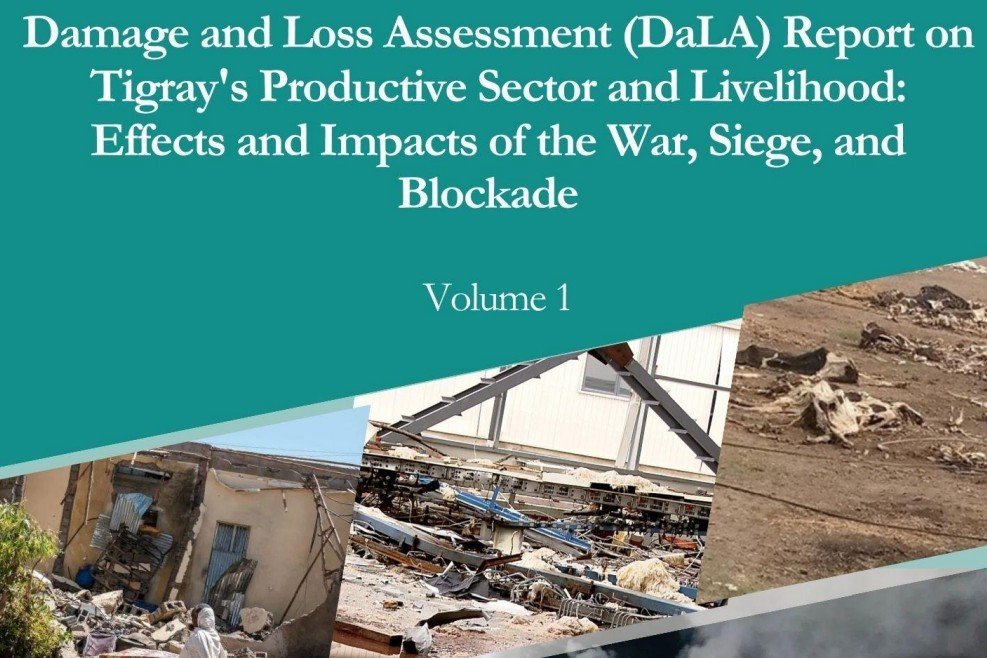
Devastating Impact on Tigray’s Productive Sector
The Commission of Inquiry on Tigray Genocide (CITG) has published an extensive report detailing the widespread destruction inflicted upon Tigray’s productive sector and household livelihoods by the war, blockade, and siege that began in November 2020. The assessment, carried out across six zones and all accessible woredas/districts, estimates the total financial impact encompassing both direct damage and future losses at approximately US$83.84 billion.
Scale and Nature of the Devastation
The findings highlight the urgent need for recovery by showing that over a quarter of the total financial impact (26.04%) was borne by the services sector, amounting to US$21.83 billion. This is closely followed by the Trade sector, which accounts for 24.70% of the total impact (US$20.71 billion), and the Manufacturing sector, responsible for 22.77% (US$19.09 billion).
The report provides one of the most detailed accounts to date of the scale and nature of the destruction by distinguishing between direct asset damage and flow losses:
- Total Direct Damage: US$33.13 billion. The services sector suffered the largest share of direct asset destruction at 41.84% (US$13.86 billion), indicating it was heavily targeted.
- Total Flow Losses: US$50.71 billion. The majority of future revenue and forgone values stem from the Manufacturing sector, which accounts for 30.79% of all losses, followed closely by Trade at 23.82%. This suggests significant long-term economic scarring in these key production and distribution areas.
Collectively, agriculture and households account for a substantial portion of the total impact, at 19.50% (US$16.35 billion) and 6.23% (US$5.22 billion), respectively.
Call to Action
The findings underscore the pressing need for comprehensive recovery and rehabilitation efforts that involve government agencies, communities, and development partners. The CITG stresses that this report should serve as a strategic guide for post-war recovery and rehabilitation in line with international standards of justice and development, emphasizing the importance of substantial investment and capacity-building to restore the region’s economic foundation and foster long-term resilience.