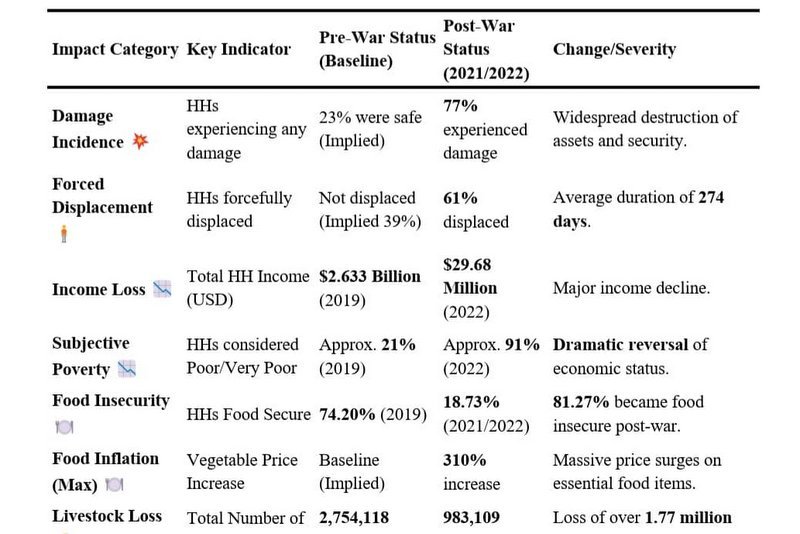
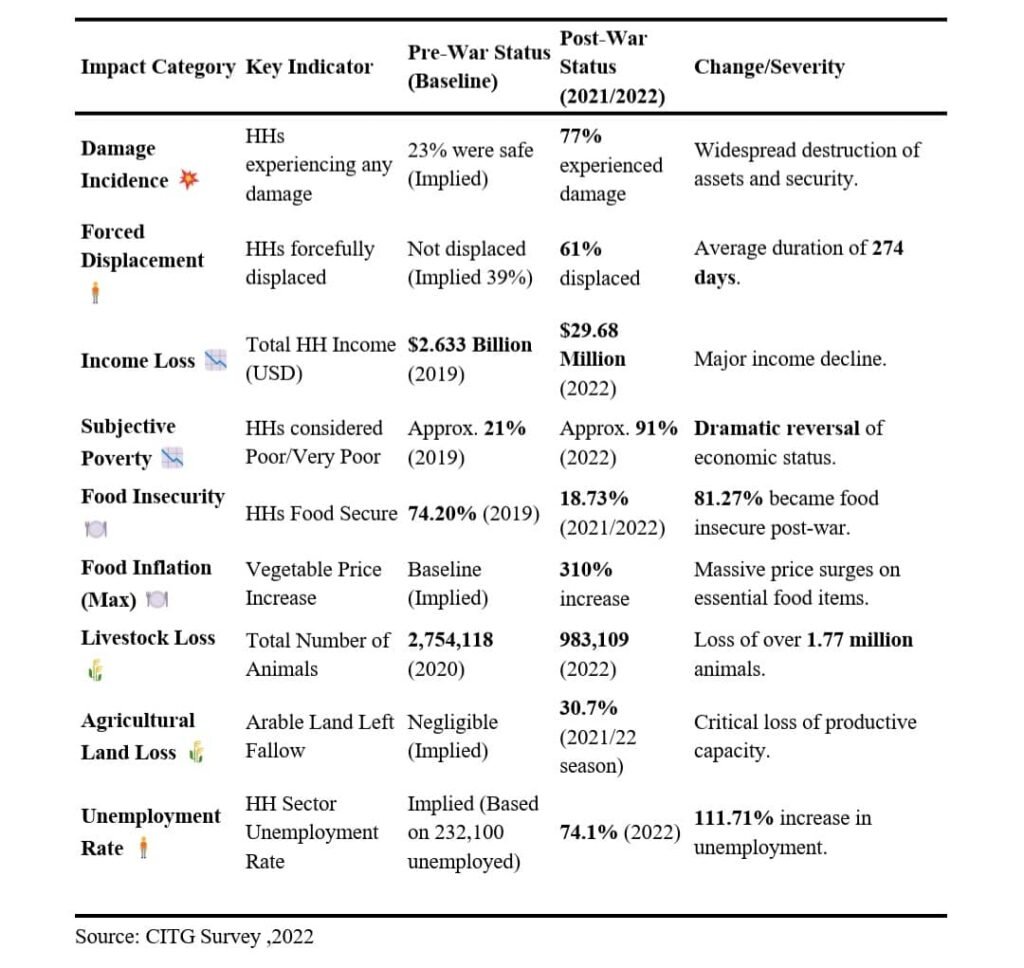
The Tigray Genocide has not only claimed the lives of hundreds of thousands of innocent civilians and exposed many to horrific sexual violence, but it has also inflicted catastrophic economic devastation. The collapse of the micro-economy, in particular, has had a devastating effect on livelihoods, with data from 657,360 households revealing its near-total destruction. According to our commission’s – CITG’s – report, the impact spans a wide range of areas, including physical damage incidence, forced displacement, loss of income, rising subjective poverty, food insecurity, inflation, livestock depletion, agricultural land loss, and soaring unemployment.
The comprehensive Damage and Loss Assessment (DaLA) for the Tigray Region’s Productive Sector estimates a catastrophic total economic impact of US$83.84 billion (US$83,840.87 million), directly caused by the war and the subsequent siege and blockage. The magnitude of this figure is fundamentally tied to the unprecedented scale and breadth of the assessment coverage, which includes 657,360 individual households and a total of 55,371 formal private firms across the productive sectors (including trade and services), alongside the entire regional financial system (18 banks and 2 microfinance institutions). By meticulously covering the entire stock of private, public, and household assets and productive capacity, the resulting monetary values represent the full, aggregated economic destruction of the region’s productive base.
The total economic effect is critically segmented into Damage (physical destruction of assets) and Loss (foregone production and income). Physical damage accounts for US$33.13 billion (39.5%), while economic loss totals US$50.71 billion (60.5%). This finding, where the total loss value significantly exceeds the damage value, points to a critical insight: the prolonged siege and blockage, which systematically cut off banking, trade, and essential services, inflicted a more severe, systemic financial collapse on the economy than the direct physical destruction from warfare alone.
The analysis of physical damage (US$33.13 billion) highlights concentrated destruction across the region’s infrastructure and private property. The services sector incurred the largest share of this destruction at US$13.86 billion (41.84% of all damage), strongly suggesting targeted action against high-value, essential civilian infrastructure. The trade sector was the second most affected, with US$8.62 billion in damage, reflecting extensive looting and demolition of commercial buildings and inventory. Critically, the Households category sustained US$1.69 billion in physical damage (5.09% of total damage). Although smaller than the damage to commercial sectors, this figure represents the direct destruction of private homes, personal assets, and household farm tools, uniquely impacting the livelihood base of the civilian population and fueling a profound displacement crisis. Agriculture (US$5.45 billion) and manufacturing (US$3.48 billion) also suffered substantial asset destruction, but the immediate physical destruction was collectively focused heavily on urban and livelihood foundations.
It is a remarkable report that reveals how Tigray has really been systematically damaged due to the war and the complete siege. The international community should immediately intervene to support Tigray for the rehabilitation, recovery, and reconstruction process, as the damage of the war is so severe at the regional level.