Ashegoda Wind Farm
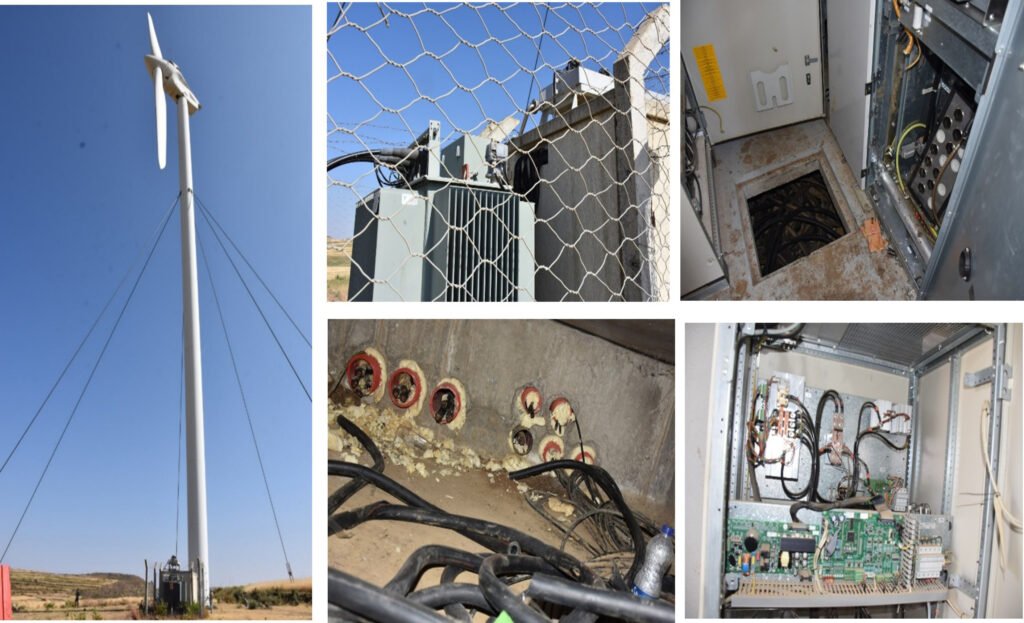
As Ethiopia’s first and largest wind farm, Ashegoda was a flagship renewable energy project designed to support the national grid. It is located approximately 24km southeast of Mekelle. The facility combines thirty 1MW Vergnet turbines and fifty-four 1.67MW Alstom turbines.
The Ashegoda Wind Farm, once a symbol of renewable energy progress not only in Ethiopia but also known as the biggest in sub-Saharan Africa, has become a blunt example of how civilian infrastructure can be systematically destroyed during war.
As part of a wider pattern, Ashegoda’s energy infrastructure was deliberately targeted during the Tigray war. The shutdown of the Ashegoda Wind Farm was the direct result of three interrelated wartime factors: first, targeted physical destruction of critical components, including damage to the T1 steel tower of an ECO-74 turbine, which severely undermined the facility’s power generation capacity; second, the complete disconnection of Tigray from the national grid in 2020, which isolated the plant and rendered any remaining electricity production unusable; and third, the comprehensive blockade imposed on the Tigray region, which blocked access to spare parts, specialized maintenance equipment, and fuel, making repairs and continued operation impossible and accelerating the facility’s deterioration.
The most devastating impacts occurred during the 2020 – 2021 wartime period. The wind farm’s performance shows a clear and disturbing trajectory: initial success and meeting of generation targets between 2014 and 2016 were followed by a sharp deterioration in 2017-2018, ultimately leading to operational collapse by 2021. This pattern makes clear that pre-existing technical and maintenance constraints were dramatically exacerbated by the Tigray war.
The bulk of the destruction was inflicted by the Ethiopian National Defense Forces (ENDF), whose attacks focused on high-value civilian energy assets. This strategy has driven the Ashegoda Wind Farm into collapse, with energy production falling from 221.8 GWh in 2016 to only 0.97 GWh in 2021, reducing 99.6% of its operational capacity and deliberately depriving civilians of a critical power source, and keeping them in darkness.
The destruction of the Ashegoda Wind Farm is a clear case of how pre-existing wartime tactics weaponized institutional fragility to ensure the complete and lasting collapse of critical civilian energy infrastructure.
For the details, see the full report, from page 80: https://citghub.org/targeted-destruction-damage-and-loss-assessment-on-tigrays-public-infrastructure-sector/