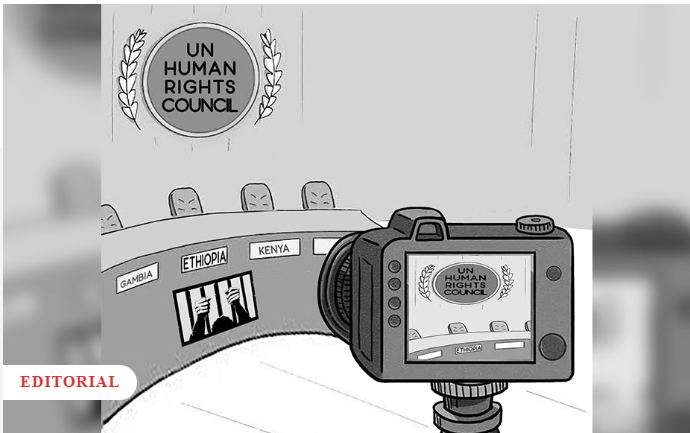
Ethiopia’s election this week to the 47-member United Nations Human Rights Council (UNHRC) for the 2025-2027 term during the 79th UN General Assemblyis certain tostirdebate both at home and abroad, revealing a series of paradoxes that highlight the complex interplay between global governance, human rights standards, and national realities. This will be Ethiopia’s third stint on the Council, following its previous memberships from 2013-2015 and 2016-2018. The election, on the one hand, signifies an acknowledgment of its potential role in promoting human rights at the international level; on the other hand, it raises questions about the implications of such a choice for Ethiopia and the global human rights landscape given the country’s ongoing human rights challenges and internal conflicts.
At the core of the paradox surrounding Ethiopia’s election to the UNHRC lies the stark disjunction between its membership in a body dedicated to promoting and protecting human rights and its actual human rights record, which has been checkered for decades now. In recent years, especially during the deadly conflict in Tigray that erupted in late 2020 as well as the insurgencies racking the Amhara and Oromia regions, the Ethiopian government has faced accusations of severe human rights violations, including extrajudicial killings, indiscriminate imprisonments, and mass displacements. Reports from the state-appointed Ethiopian Human Rights Commission and several other human rights organizations have chronicled atrocities committed by both government forces and the groups which are waging an armed struggle. This juxtaposition raises an essential question: how can a country with documented human rights abuses assume a role in a council devoted to advocating for human rights? Critics contend that Ethiopia’s election undermines the credibility of the UNHRC, suggesting that the body is prioritizing political considerations over the mandates of human rights protection. This paradox reflects a broader issue within the UN system, where geopolitical interests often overshadow genuine commitments to human rights. Read more